
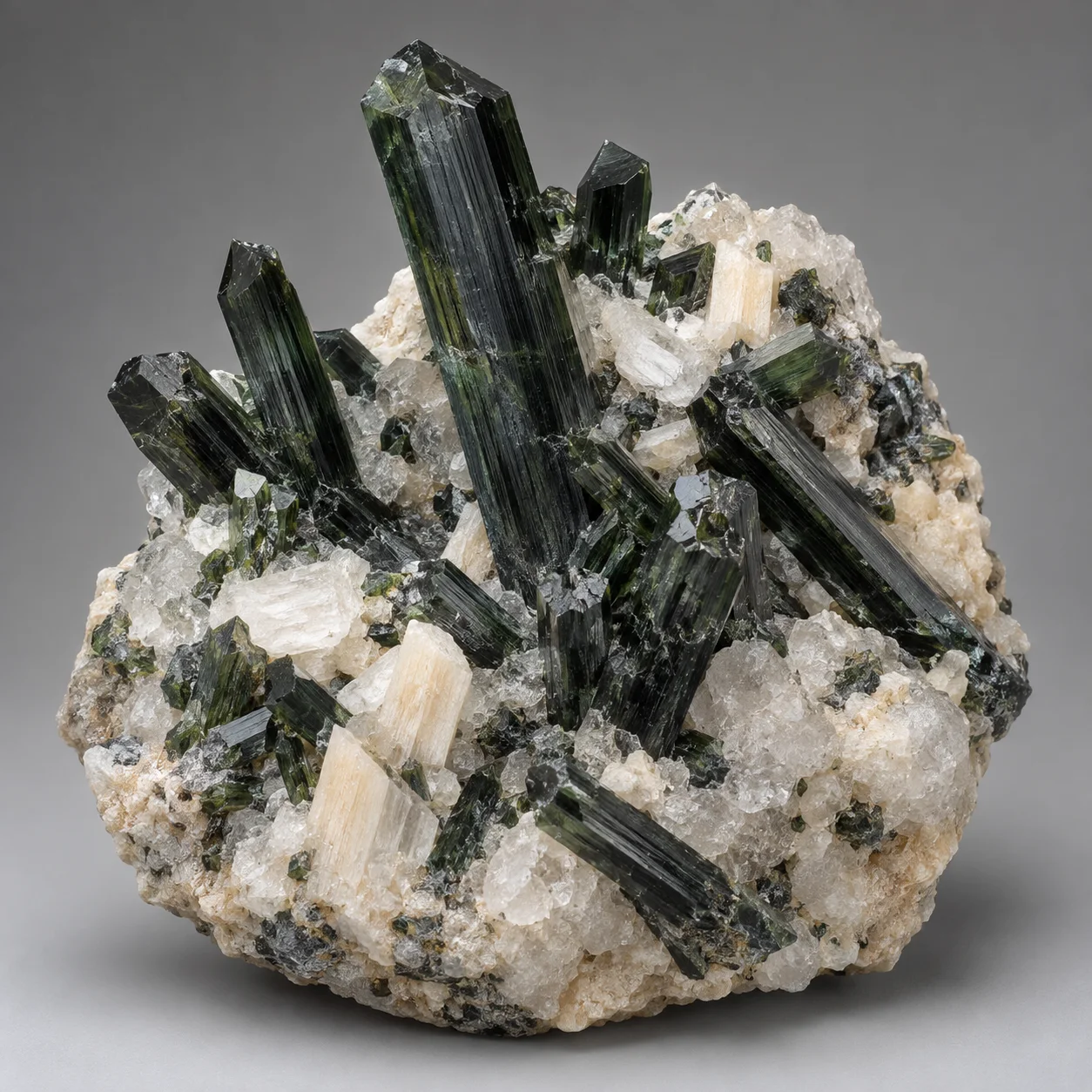
Minerals occur in company
A mineral name identifies a species, but an assemblage records an environment. At the Dara-i-Pioz alkaline complex in northern Tajikistan, dark aegirine is documented with quartz, albite, baratovite, miserite, and other uncommon phases. Their textures and relationships allow researchers to reconstruct processes that a loose crystal could not reveal.
A sodium and iron signal
Aegirine is a sodium–ferric-iron pyroxene. Its presence fits strongly alkaline, sodium-rich mineral-forming conditions. In the studied quartz–albite–aegirine rock, mineral chemistry and texture were interpreted as evidence of metasomatic alteration of alkaline syenite: fluids changed an earlier rock while introducing, removing, and redistributing components.
Why context changes identification
Dark prismatic habit may suggest aegirine, but appearance is not proof. Near-right-angle pyroxene cleavage, optical behaviour, chemistry, and diffraction provide stronger tests. Geological company narrows the possibilities too: an alkaline assemblage tells a different story from a visually similar dark crystal in an ordinary granite or metamorphic rock.
A locality is evidence, not a collecting map
Project Sang presents Dara-i-Pioz at approximate public precision. The scientific value lies in the documented assemblage and published analysis, not in exposing an exact collecting point. Regional context, source records, and cautious imagery preserve that distinction.
DISCUSSION
Comments 0