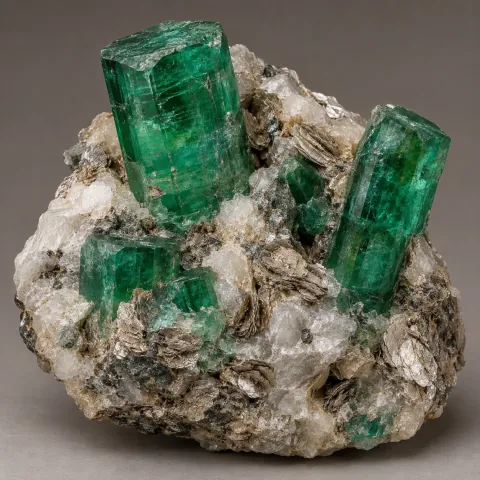
Emerald
Be₃Al₂Si₆O₁₈

COMPARE
Put up to four minerals or gems next to each other and test them like a gemmologist.
Be₃Al₂Si₆O₁₈
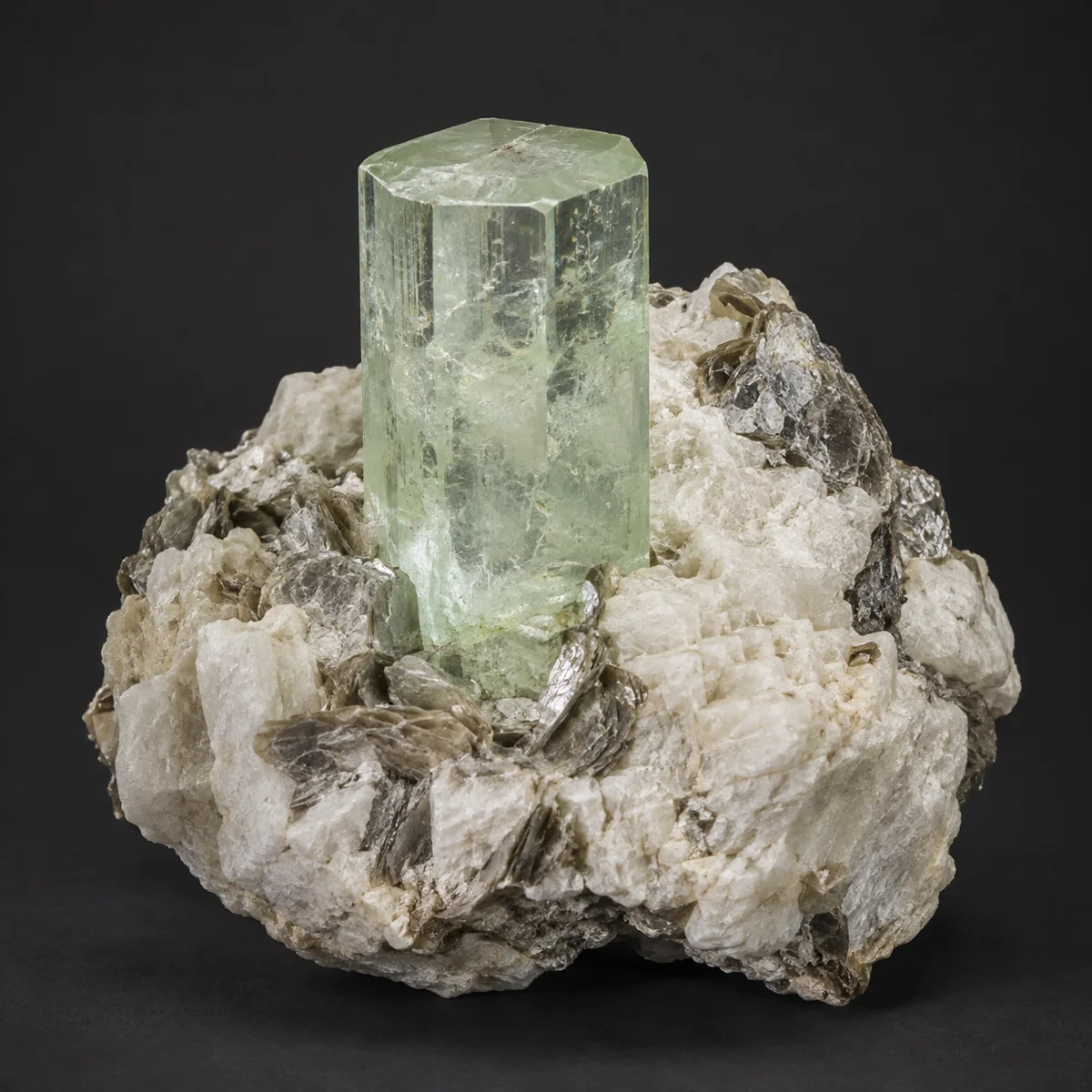
Be₃Al₂Si₆O₁₈
VERDICT
THE TESTS
Mohs hardness: a mineral scratches anything softer than itself.
Density in g/cm³: denser stones sink deeper.
Refractive index: how strongly the stone bends light. See light bend through a 3D crystal →
Between crossed polarisers a doubly refractive stone blinks as it turns; a singly refractive one stays dark. See light bend through a 3D crystal →
Unit cells side by side. Drag any of them: they all turn together.
EmeraldHexagonal
BerylHexagonal
PROPERTIES
| Emerald | Beryl | |
|---|---|---|
| Type | Gem | Mineral |
| Mineral | Beryl | Beryl |
| Formula | Be₃Al₂Si₆O₁₈ | Be₃Al₂Si₆O₁₈ |
| Mineral group | Silicates | Silicates |
| Crystal system | Hexagonal | Hexagonal |
| Mohs hardness | 7.5 | 7.5 |
| Density | 2.63–2.97 g/cm³ | 2.63–2.97 g/cm³ |
| Refractive index | nω about 1.568–1.602; nε about 1.564–1.595 | nω about 1.568–1.602; nε about 1.564–1.595 |
| Optical class | Uniaxial (−) | Uniaxial (−) |
| Colour | Green to bluish green | Colourless, green, blue, yellow, pink, red, or white |
| Treatments | Emeralds typically contain inclusions visible to the unaided eye, often called jardin ("garden"). GIA's laboratory classifies emerald clarity treatments as minor, moderate or significant. | — |
| Look-alikes | Green beryl whose colour is too light is not called emerald, although it is the same mineral. | — |
| Crystal habit | Usually hexagonal prisms, sometimes tabular; crystals may be vertically striated, etched, or exceptionally large in pegmatites. | Usually hexagonal prisms, sometimes tabular; crystals may be vertically striated, etched, or exceptionally large in pegmatites. |
| Cleavage | Imperfect basal cleavage | Imperfect basal cleavage |
| Fracture | Conchoidal to uneven | Conchoidal to uneven |
| Tenacity | Brittle | Brittle |
| Luster | Vitreous to resinous | Vitreous to resinous |
| Streak | White | White |
| Transparency | Transparent to translucent | Transparent to translucent |
| Fluorescence | Usually weak or inert; response varies with colour centres and impurities. | Usually weak or inert; response varies with colour centres and impurities. |
| Identification | Recognise hexagonal prisms, hardness 7.5–8, relatively low density, and imperfect basal cleavage. Emerald and aquamarine are coloured beryl, sharing the same ring-silicate framework. | Recognise hexagonal prisms, hardness 7.5–8, relatively low density, and imperfect basal cleavage. Emerald and aquamarine are coloured beryl, sharing the same ring-silicate framework. |
| In Tajikistan | — | Kukurt pegmatite field, Eastern Pamir |
| Source | Handbook of Mineralogy — Beryl | Handbook of Mineralogy — Beryl |