
Native elements · Sourced PROFILE
Diamond
C
Crystalline carbon and the hardest natural material, prized as a gemstone and important as a recorder of conditions deep in Earth's mantle.
AT A GLANCE
- Formula
- C
- Crystal system
- Cubic
- Space group
- Fd̅3m
- Mohs hardness
- 10
- Density
- 3.52 g/cm³
- Optical character
- Isotropic
CRYSTALLOGRAPHY
Crystal form & structure
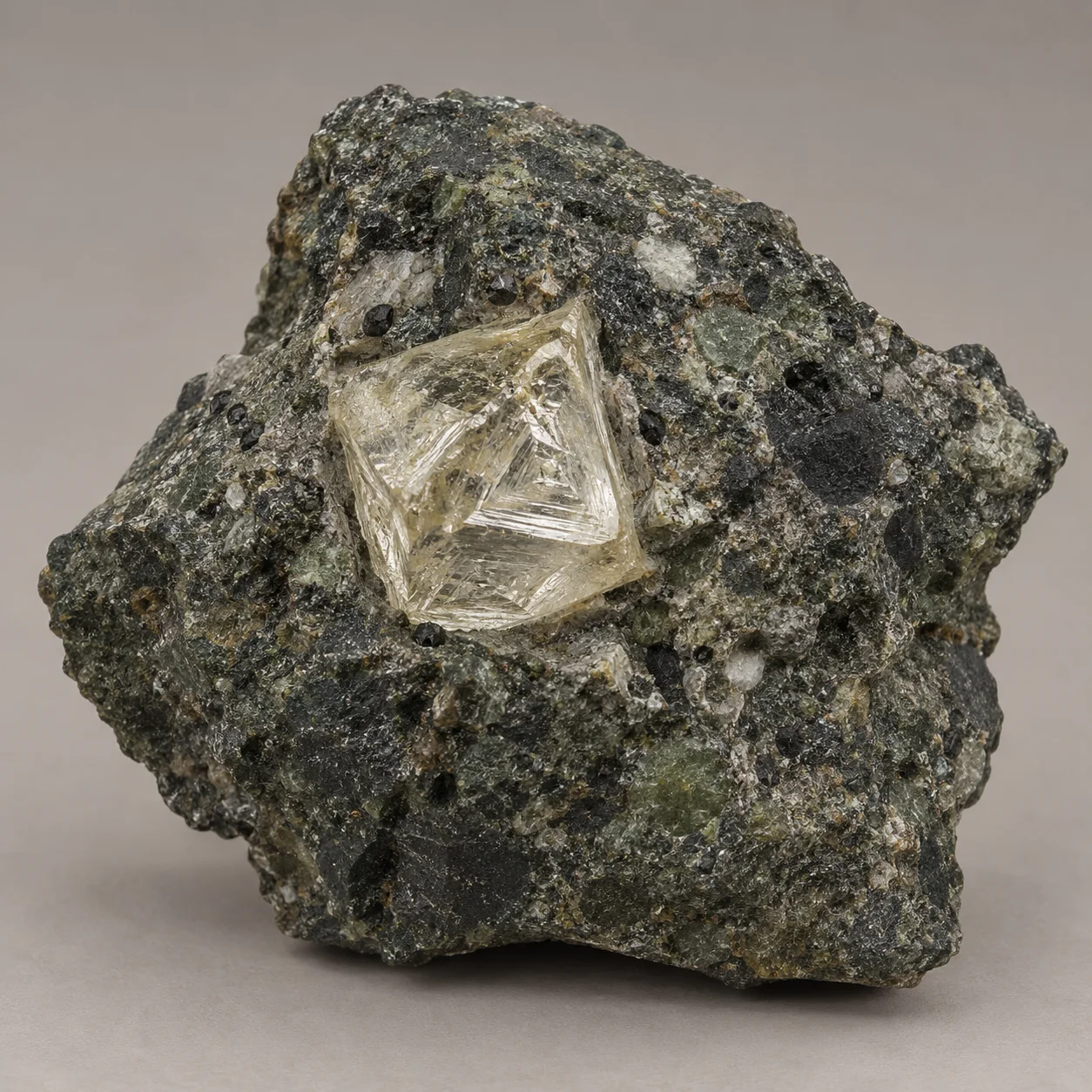
Most commonly octahedral, dodecahedral or cubic crystals; faces may show triangular growth or dissolution features.
HAND-SAMPLE PROPERTIES
Physical properties
- Cleavage
- Perfect on {111}
- Fracture
- Conchoidal
- Tenacity
- Brittle despite exceptional hardness
- Streak
- White
- Luster
- Adamantine
- Transparency
- Transparent to opaque
- Observed colours
- Usually colourless to pale yellow or brown; also blue, green, pink, red, orange, violet, grey or black
LIGHT & OPTICS
Optical properties
- Optical class
- Isotropic
- Refractive index
- n 2.417
- Fluorescence & electrical behaviour
- Fluorescence varies; blue is common, but response and strength are not diagnostic by themselves.
GEOLOGICAL SETTING
Formation
Most natural diamonds crystallize at great depth in the mantle and reach the surface in rapidly emplaced kimberlite or lamproite.
MINERAL COMPANY
Common associations
Kimberlite and lamproite minerals including olivine, pyrope garnet, chromite and diopside
FIELD NOTES
How to identify it
Mohs hardness 10, adamantine luster, perfect octahedral cleavage and very high thermal conductivity are characteristic; reliable identification requires gemological testing.
NAME & HISTORY
Where the name comes from
From Greek adamas, meaning unconquerable or invincible.
SCIENTIFIC SOURCE
Handbook of Mineralogy — Diamond
External reference; factual profile paraphrased and attributed. Copyright remains with the publisher.
PROVENANCE
Documented occurrences
No locality record is published for this mineral yet. General species science above does not prove occurrence in Tajikistan.