
Silicates · Sourced PROFILE
Titanite
CaTiSiO₅
A calcium–titanium silicate found in small amounts in many plutonic and metamorphic rocks; its uranium–lead ages help date the deep crust exposed in Pamir gneiss domes.
AT A GLANCE
- Formula
- CaTiSiO₅
- Crystal system
- Monoclinic
- Space group
- P2₁/a
- Mohs hardness
- 5–5.5
- Density
- 3.48–3.60 g/cm³
- Optical character
- Biaxial (+); distinctly pleochroic when deeply coloured; strong dispersion
CRYSTALLOGRAPHY
Crystal form & structure
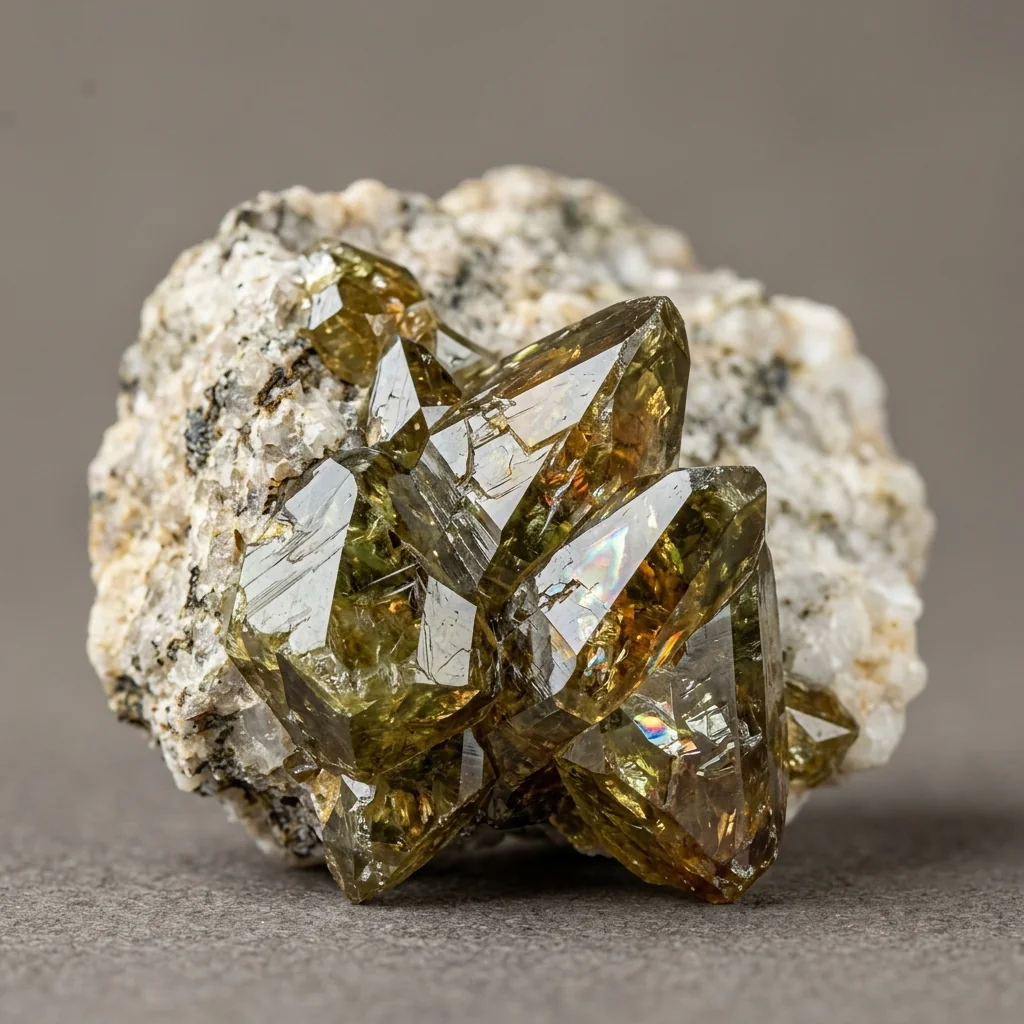
Wedge-shaped crystals flattened on {001}, or prismatic along [110], up to 16 cm; also compact or massive. Contact and penetration twins on {100}.
HAND-SAMPLE PROPERTIES
Physical properties
- Cleavage
- Good on {110}; parting on {221} from twinning
- Fracture
- Not stated in the cited profile
- Tenacity
- Not stated in the cited profile
- Streak
- White
- Luster
- Adamantine to resinous
- Transparency
- Transparent to opaque
- Observed colours
- Black, brown, grey, colourless, green, yellow or red
LIGHT & OPTICS
Optical properties
- Optical class
- Biaxial (+); distinctly pleochroic when deeply coloured; strong dispersion
- Refractive index
- nα 1.843–1.950; nβ 1.870–2.034; nγ 1.943–2.110
- Fluorescence & electrical behaviour
- No diagnostic fluorescence is reported in the cited profile.
GEOLOGICAL SETTING
Formation
A common accessory mineral in intermediate and felsic plutonic rocks, pegmatites and alpine veins; also in gneisses, schists and some skarns.
MINERAL COMPANY
Common associations
Albite, chlorite, epidote, apatite, allanite, monazite, magnetite, ilmenite, nepheline, biotite, diopside and calcite
FIELD NOTES
How to identify it
Wedge-shaped crystals, adamantine to resinous lustre, hardness 5–5.5 and very strong dispersion are typical clues; radiation-damaged (metamict) grains also occur.
NAME & HISTORY
Where the name comes from
Named for the titanium in its composition.
SCIENTIFIC SOURCE
Handbook of Mineralogy — Titanite
External reference; factual profile paraphrased and attributed. Copyright remains with the publisher.
PROVENANCE
Documented occurrences
Shakhdara–Alichur gneiss dome, South-West Pamir · Titanite from the dome is dated by U/Th–Pb methods, together with monazite and zircon, to show that doming began about 21–20 million years ago. Region-level context only.
Sourced · Region precisionThe giant Shakhdara migmatitic gneiss dome, Pamir, India–Asia collision zone: 2. Timing of dome formation