
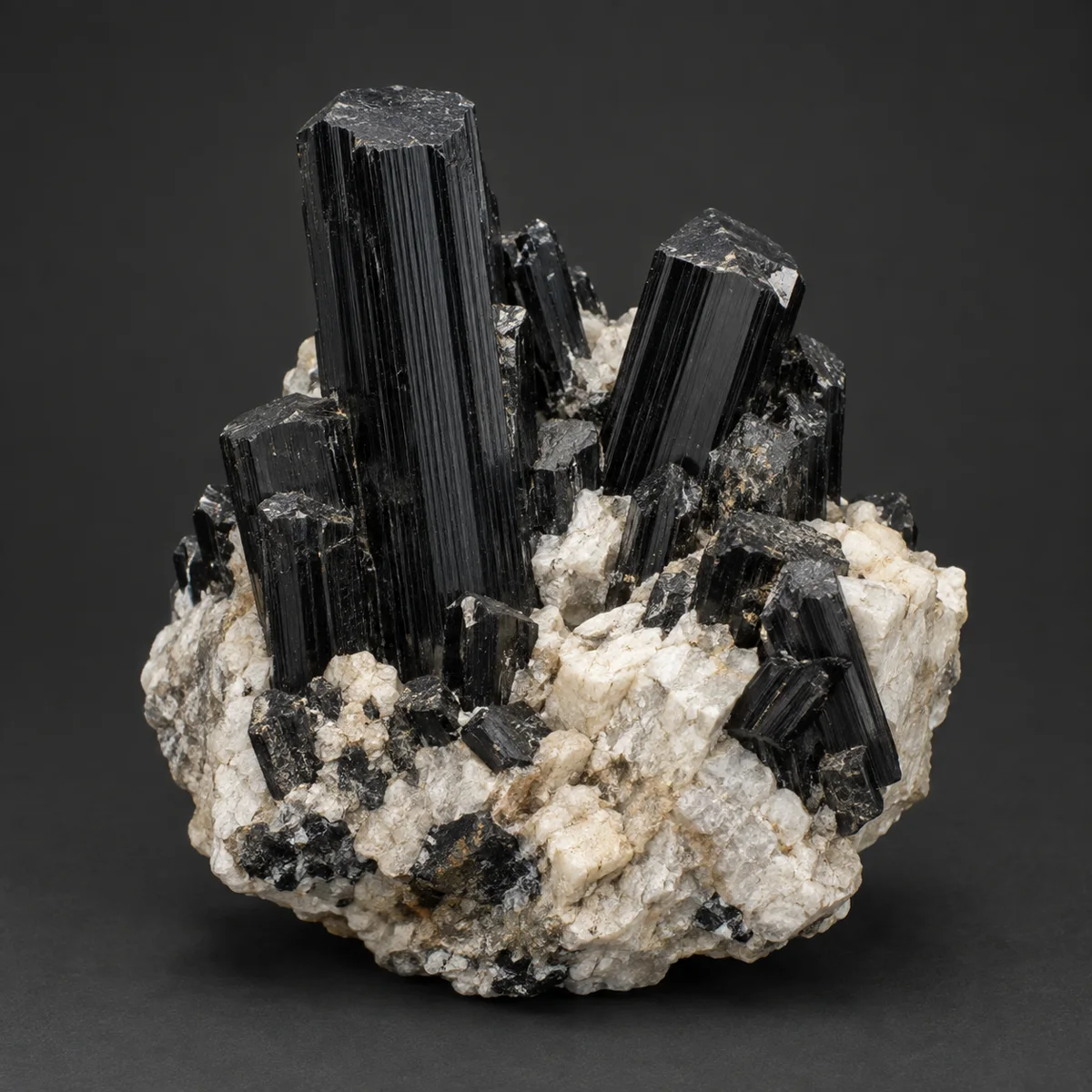
Silicates · Sourced PROFILE
Tourmaline
Complex borosilicate
A chemically complex mineral group known for its wide range of colours.
AT A GLANCE
- Formula
- Complex borosilicate
- Crystal system
- Trigonal
- Space group
- R3m (schorl)
- Mohs hardness
- 7
- Density
- 3.18–3.22 g/cm³ for schorl
- Optical character
- Uniaxial (−), strongly pleochroic in many members
CRYSTALLOGRAPHY
Crystal form & structure
Tourmalines commonly form long, vertically striated three- or six-sided prisms. This reference profile uses schorl, the common iron-rich black species.
HAND-SAMPLE PROPERTIES
Physical properties
- Cleavage
- Very poor on prismatic and basal directions
- Fracture
- Uneven to conchoidal
- Tenacity
- Brittle
- Streak
- White
- Luster
- Vitreous to resinous
- Transparency
- Opaque to translucent; some tourmaline species are transparent
- Observed colours
- Black for schorl; the tourmaline group as a whole spans nearly every colour
LIGHT & OPTICS
Optical properties
- Optical class
- Uniaxial (−), strongly pleochroic in many members
- Refractive index
- Schorl: nω about 1.650–1.672; nε about 1.635–1.650
- Fluorescence & electrical behaviour
- Generally inert to weak; tourmalines are both pyroelectric and piezoelectric.
GEOLOGICAL SETTING
Formation
Occurs especially in pegmatites and metamorphic rocks influenced by boron-rich fluids.
MINERAL COMPANY
Common associations
Quartz, feldspars, micas, beryl, garnet, cassiterite, and pegmatite or metamorphic minerals
FIELD NOTES
How to identify it
Striated prisms, rounded triangular cross-sections, hardness near 7, and poor cleavage are strong clues. Exact species cannot reliably be assigned from colour alone; chemistry is required.
NAME & HISTORY
Where the name comes from
Tourmaline derives through older European forms from Sinhalese toramalli, once used for mixed gems from Sri Lanka.
SCIENTIFIC SOURCE
Handbook of Mineralogy — Schorl (reference species for tourmaline)
External reference; factual profile paraphrased and attributed. Copyright remains with the publisher.
PROVENANCE
Documented occurrences
Kukurt pegmatite field, Eastern Pamir · Schorl is documented as a rock-forming mineral in the Dorozhny pegmatite and occurs in the reported boron-rich mineral association. The public record remains at regional precision.
Sourced · Region precisionBadakhshanite-(Y), a new mineral species from a granite miarolitic pegmatite in Eastern Pamir (Pautov et al., 2020)