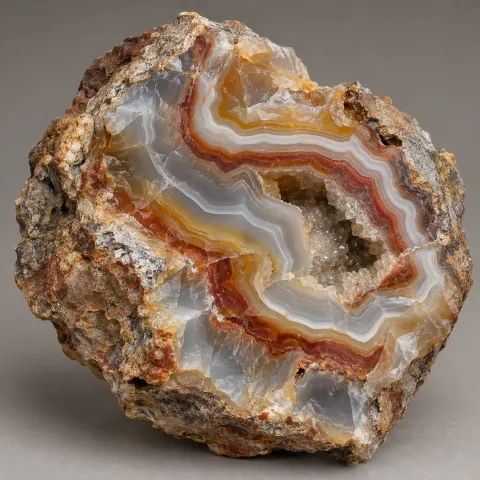
Agate
SiO₂

COMPARE
Put up to four minerals or gems next to each other and test them like a gemmologist.
SiO₂
Add one more to compare.
PROPERTIES
| Agate | |
|---|---|
| Type | Gem |
| Mineral | Quartz |
| Formula | SiO₂ |
| Mineral group | Silicates |
| Crystal system | Trigonal |
| Mohs hardness | 7 |
| Density | 2.65 g/cm³ |
| Refractive index | ω 1.544; ε 1.553 |
| Optical class | Uniaxial (+) |
| Colour | Brown, white, red, grey, pink, black or yellow, typically in bands |
| Colour cause | Agate forms when silica carried by groundwater is deposited in cavities, in concentric layers around the walls or in horizontal layers building up from the bottom. Its colours come from impurities: groundwaters of different compositions seeping into the cavity leave alternating bands that record changes in water chemistry. |
| Treatments | Agate is porous and readily accepts dye; most of the spectacularly coloured agates sold in the gemstone trade have been dyed. |
| Look-alikes | Some petrified wood is called "agatized wood" and taken for agate, but it is chalcedony. |
| Crystal habit | Commonly a six-sided prism terminated by rhombohedra; also drusy, fibrous, microcrystalline as chalcedony, or massive. More than 500 crystal forms are reported. |
| Cleavage | Rarely observable; poor on rhombohedral and prismatic directions |
| Fracture | Conchoidal |
| Tenacity | Brittle; tough when massive |
| Luster | Vitreous; waxy to dull in massive varieties |
| Streak | White |
| Transparency | Transparent to nearly opaque |
| Fluorescence | Usually inert; response varies with inclusions. Piezoelectric and pyroelectric, and sometimes triboluminescent. |
| Identification | Hardness 7 scratches ordinary glass; conchoidal fracture and absent obvious cleavage separate it from feldspar. Calcite is much softer and reacts with dilute acid. |
| In Tajikistan | Banded chalcedony agate is known from the Adrasman agate occurrence in the Adrasman–Kanimansur ore field and near Dolany village, Sughd region; specimens are held in the Fersman Mineralogical Museum. |
| Source | Handbook of Mineralogy — Quartz |