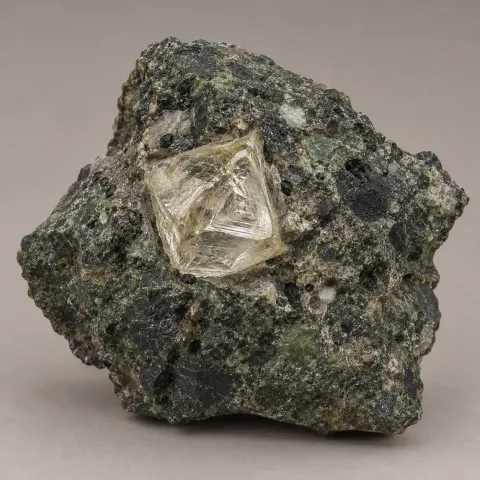
Diamond
C

COMPARE
Put up to four minerals or gems next to each other and test them like a gemmologist.
C
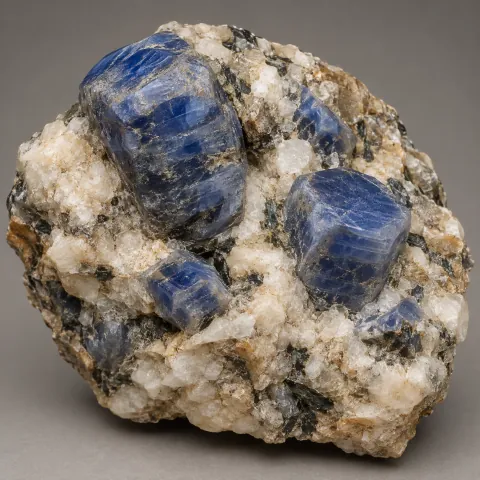
Al₂O₃
VERDICT
THE TESTS
Mohs hardness: a mineral scratches anything softer than itself.
Density in g/cm³: denser stones sink deeper.
Refractive index: how strongly the stone bends light. See light bend through a 3D crystal →
Between crossed polarisers a doubly refractive stone blinks as it turns; a singly refractive one stays dark. See light bend through a 3D crystal →
Unit cells side by side. Drag any of them: they all turn together.
DiamondCubic
SapphireTrigonal
PROPERTIES
| Diamond | Sapphire | |
|---|---|---|
| Type | Gem | Gem |
| Mineral | Diamond | Corundum |
| Formula | C | Al₂O₃ |
| Mineral group | Native elements | Oxides |
| Crystal system | Cubic | Trigonal |
| Mohs hardness | 10 | 9 |
| Density | 3.52 g/cm³ | 3.98–4.10 g/cm³ |
| Refractive index | n 2.417 | nω about 1.767–1.772; nε about 1.759–1.763 |
| Optical class | Isotropic | Uniaxial (−) |
| Colour | Colourless and fancy colours | Blue and every non-red gem colour |
| Colour cause | — | Traces of iron and titanium — only a few hundredths of a percent — turn corundum blue; more iron gives a darker blue. Chromium produces pink sapphire. Sapphire also occurs in violet, green, yellow, orange, purple, grey, black and brown. |
| Look-alikes | Colourless sapphire was once a popular diamond imitation (see Sapphire). | Colourless sapphire was once a popular diamond imitation. Laboratory-grown sapphire is durable enough to be used for supermarket-scanner and spacecraft windows. |
| Crystal habit | Most commonly octahedral, dodecahedral or cubic crystals; faces may show triangular growth or dissolution features. | Barrel-shaped, pyramidal, tabular, or prismatic crystals; also granular and massive. Parting and growth features may be prominent. |
| Cleavage | Perfect on {111} | No true cleavage; common basal and rhombohedral parting |
| Fracture | Conchoidal | Uneven to conchoidal |
| Tenacity | Brittle despite exceptional hardness | Brittle, but compact material is tough |
| Luster | Adamantine | Adamantine to vitreous |
| Streak | White | White |
| Transparency | Transparent to opaque | Transparent to opaque |
| Fluorescence | Fluorescence varies; blue is common, but response and strength are not diagnostic by themselves. | Variable; ruby may fluoresce red under ultraviolet light and some material phosphoresces. |
| Identification | Mohs hardness 10, adamantine luster, perfect octahedral cleavage and very high thermal conductivity are characteristic; reliable identification requires gemological testing. | Its hardness of 9 is decisive: it scratches nearly every common mineral. High density and parting help distinguish it; ruby and sapphire are colour varieties of corundum, not separate mineral species. |
| In Tajikistan | — | Sapphire is documented together with ruby at the Snezhnoe deposit in the Kukurt district, Eastern Pamir. |
| Source | Handbook of Mineralogy — Diamond | Handbook of Mineralogy — Corundum |