
Mineraloids · Sourced PROFILE
Opal
SiO₂·nH₂O
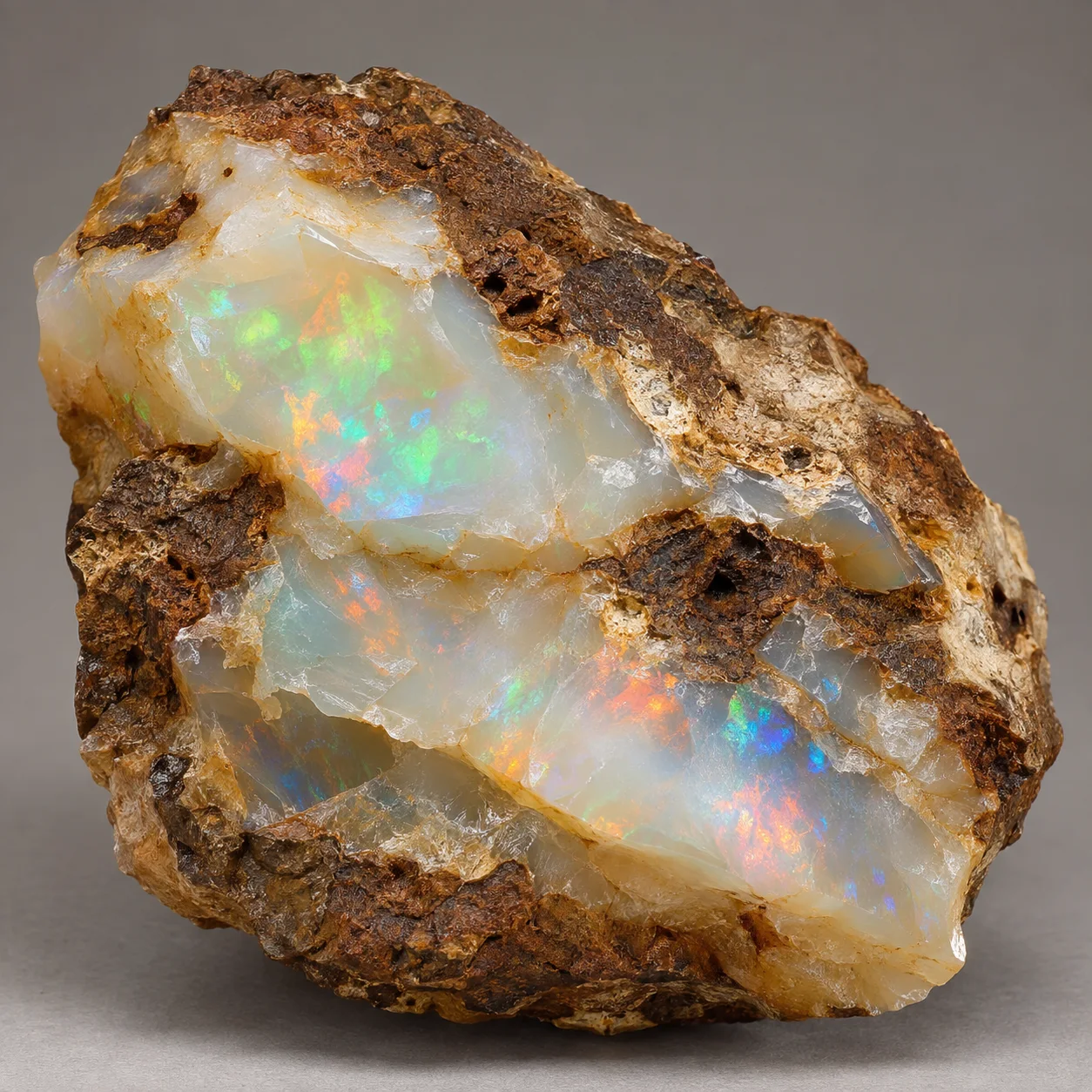
A hydrated amorphous silica mineraloid; ordered silica spheres in precious opal can produce play-of-colour.
AT A GLANCE
- Formula
- SiO₂·nH₂O
- Crystal system
- Amorphous
- Space group
- Not applicable — amorphous
- Mohs hardness
- 5.5–6.5
- Density
- About 1.9–2.3 g/cm³
- Optical character
- Isotropic, commonly with anomalous optical effects
CRYSTALLOGRAPHY
Crystal form & structure
Massive, botryoidal, stalactitic, vein-filling or replacing material; no true crystals.
HAND-SAMPLE PROPERTIES
Physical properties
- Cleavage
- None
- Fracture
- Conchoidal to uneven
- Tenacity
- Brittle
- Streak
- White
- Luster
- Vitreous to waxy
- Transparency
- Transparent to opaque
- Observed colours
- Colourless, white, yellow, orange, red, brown, green, blue, grey or black; precious material may show spectral play-of-colour
LIGHT & OPTICS
Optical properties
- Optical class
- Isotropic, commonly with anomalous optical effects
- Refractive index
- n about 1.37–1.47
- Fluorescence & electrical behaviour
- Fluorescence and phosphorescence vary strongly with composition and locality.
GEOLOGICAL SETTING
Formation
Forms when silica-bearing water deposits hydrated silica in cavities, fractures, sediments, or weathering zones.
MINERAL COMPANY
Common associations
Chalcedony, quartz, cristobalite, calcite, zeolites and iron oxides
FIELD NOTES
How to identify it
Low hardness, conchoidal fracture, lack of cleavage and waxy-to-vitreous appearance are useful clues. Play-of-colour identifies precious opal but is absent from common opal.
NAME & HISTORY
Where the name comes from
From Latin opalus, through Greek opallios; the deeper origin is uncertain.
SCIENTIFIC SOURCE
Handbook of Mineralogy — Opal
External reference; factual profile paraphrased and attributed. Copyright remains with the publisher.
PROVENANCE
Documented occurrences
No locality record is published for this mineral yet. General species science above does not prove occurrence in Tajikistan.