
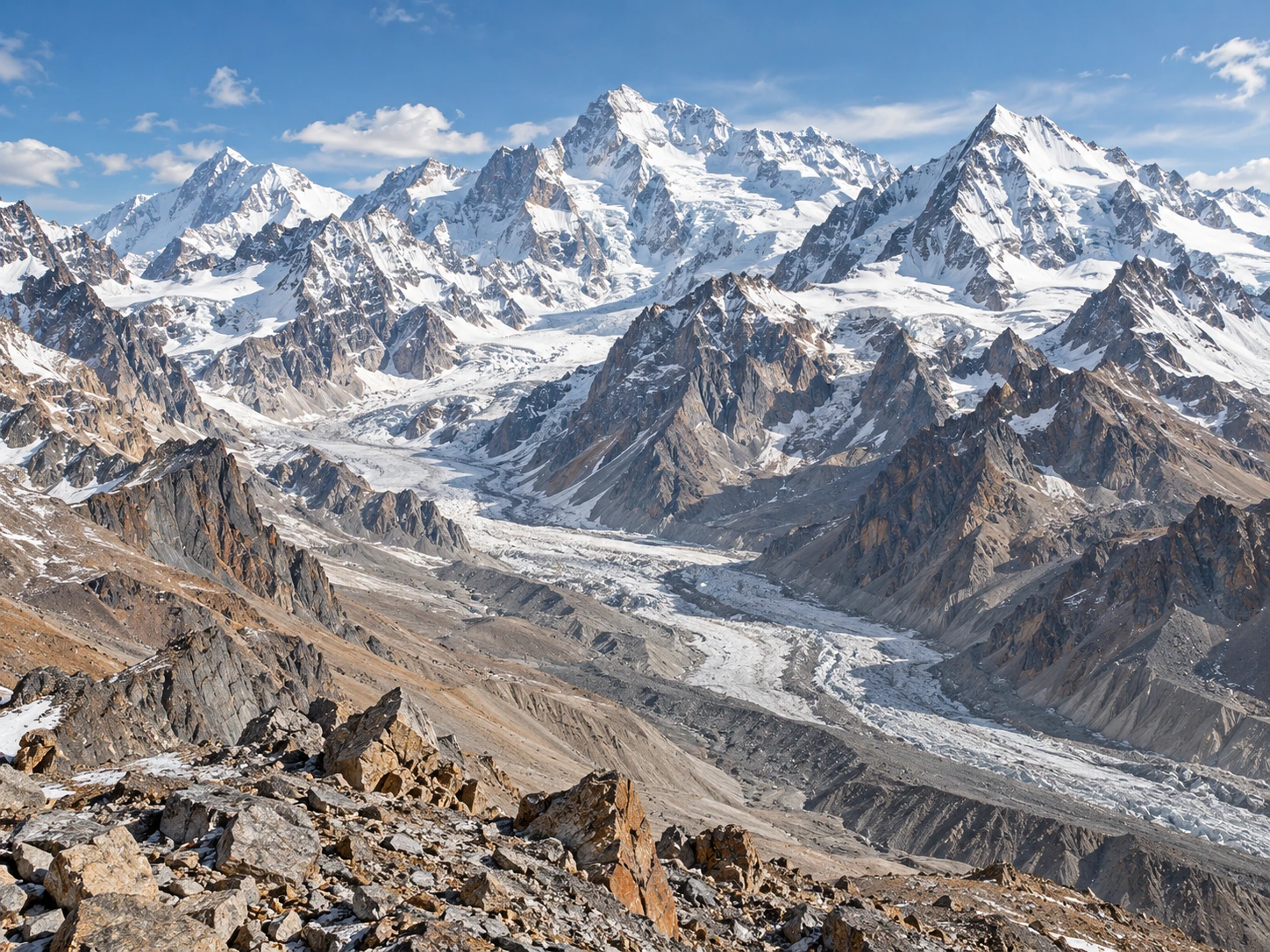
An exposure is the end of a journey
The metamorphic rocks visible in the Pamir today did not form at the surface. Parts of the Central and South Pamir preserve crust that was buried, heated, deformed, partially melted, and later exhumed. Gneiss domes expose this deeper record, but their present shape is only the final frame of a long tectonic history.
Minerals can keep time
Minerals such as titanite incorporate trace elements and radioactive isotopes as they grow or recrystallize. Petrochronology connects those dates to chemical zones and metamorphic reactions, allowing researchers to place mineral growth within episodes of burial, heating, melting, and cooling rather than treating every date as an isolated number.
From thickening to exhumation
Studies of Pamir gneiss domes record Cenozoic crustal thickening followed by Miocene exhumation. In the Shakhdara dome, structural relationships and several thermochronometers constrain rapid cooling and dome development. Across the domes, normal-sense shear zones and extension helped bring hot middle-to-lower crust upward while erosion removed overlying rock.
What the landscape does not show by itself
A mountain view cannot identify the age or pressure history of a rock. Those interpretations depend on mapped structures, mineral textures, isotope systems, and reproducible analytical models. The landscape becomes geologically legible only when field relationships and mineral-scale evidence are read together.
Assalom, kase hast?
Bale hast
Ha, man hastam
Oo