
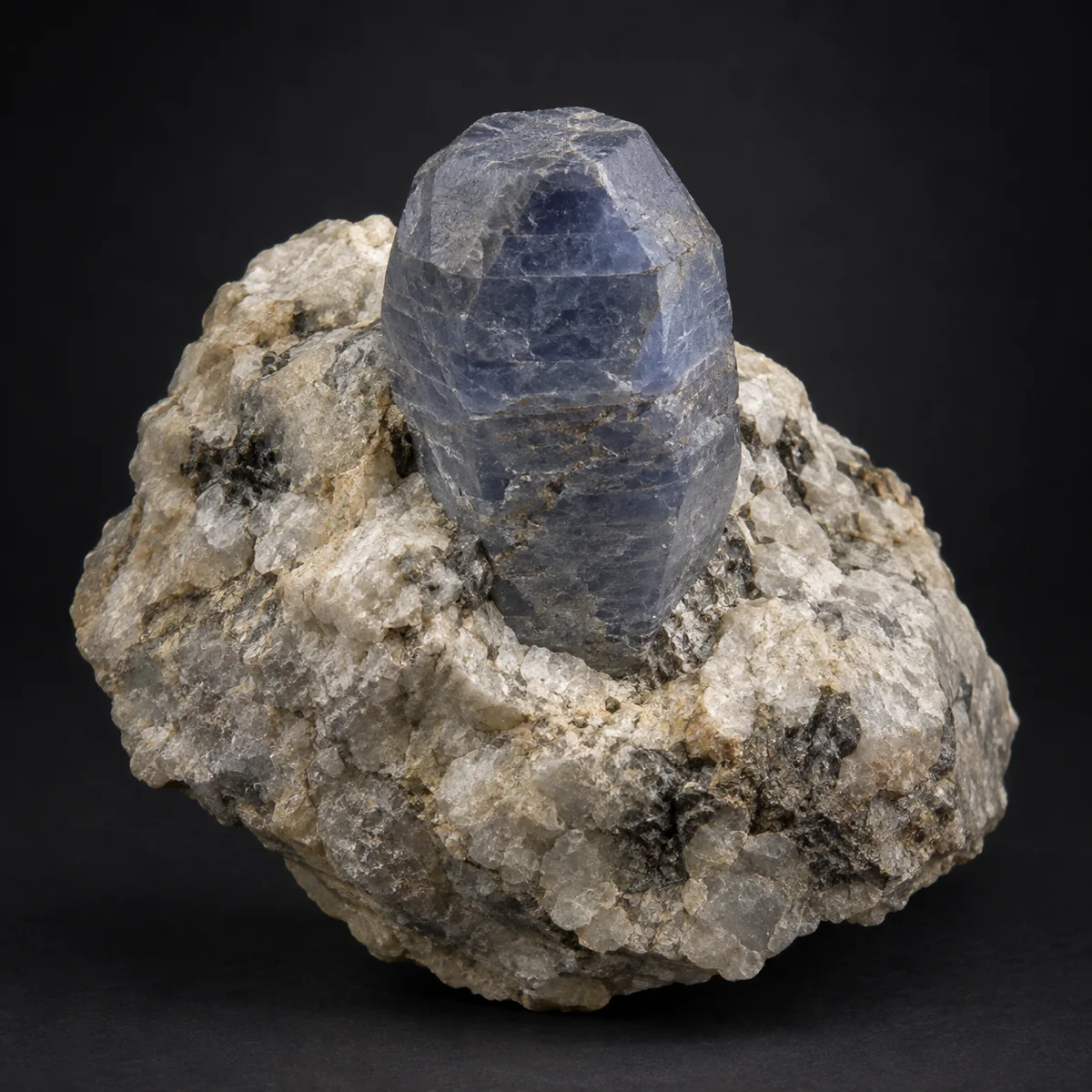
The attractive clue
Colour is often the first property we notice. It is also one of the easiest to misread. Trace elements, structural defects, inclusions, weathering, lighting, and treatment can make one mineral appear in many colours—or make unrelated minerals look deceptively similar.
A combination of evidence
A useful identification starts with several observations together. Hardness narrows the possibilities. Cleavage and fracture describe how a specimen breaks. Crystal habit records the geometry of growth, while density, streak, luster, and optical behaviour add independent tests. No single clue has to carry the whole conclusion.
Ruby, sapphire, and red spinel
Ruby and sapphire are colour varieties of corundum. Red spinel can resemble ruby closely, and historic stones were sometimes named before modern mineralogical testing separated them. Corundum has Mohs hardness 9 and is optically anisotropic; spinel has hardness 7.5–8 and is isotropic. Those structural properties are more dependable than redness alone.
Responsible identification
Photographs can support learning, but they rarely prove an identification by themselves. Project Sang therefore connects visual records to measured properties, geological context, and inspectable sources—and labels editorial illustrations as illustrations rather than specimens.
Assalom
Waaleykum salom
Hellio
Mmm
Ahahah
Hdjdhdb
😀😀😀
😁😁😁
Aloo