
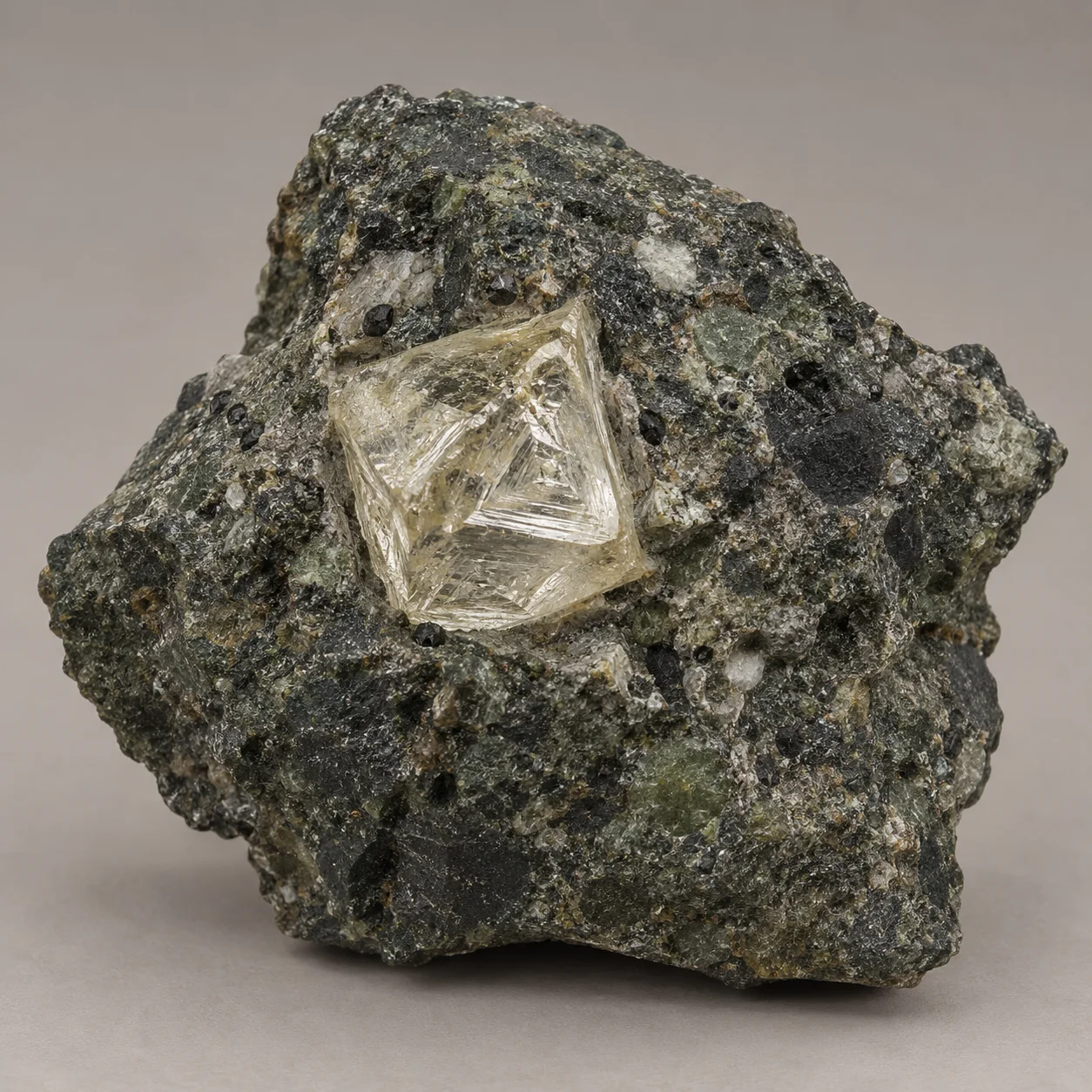
One test, one question
The Mohs scale asks which material can scratch another. It is an ordinal comparison of scratch resistance, not a promise that a stone will survive impact, pressure, or a fall. A value of ten makes diamond exceptionally hard, but it does not make every diamond indestructible.
Why a hard crystal can break
Diamond has perfect cleavage on octahedral planes and is described as brittle. A blow aligned with one of those structural weaknesses can split it even though few materials can scratch its surface. Corundum has hardness nine and lacks true cleavage, while quartz has hardness seven and commonly breaks with a conchoidal fracture. Those differences matter when a crystal is cut, mounted, handled, or identified.
Hardness, cleavage, fracture, toughness
Hardness describes scratching. Cleavage describes repeated breakage along crystallographic planes. Fracture describes breakage away from cleavage, and toughness describes resistance to breaking, chipping, or deformation. These properties arise from atomic structure in different ways, so no single number replaces the others.
Read a property as evidence
A scratch test can damage a specimen and should not be the first test on a valuable or documented object. Good identification combines non-destructive observations with measured properties and, where needed, optical, chemical, or diffraction analysis. The useful lesson is not that one mineral is strongest, but that every test answers a limited question.
МУҲОКИМА
Шарҳҳо 0