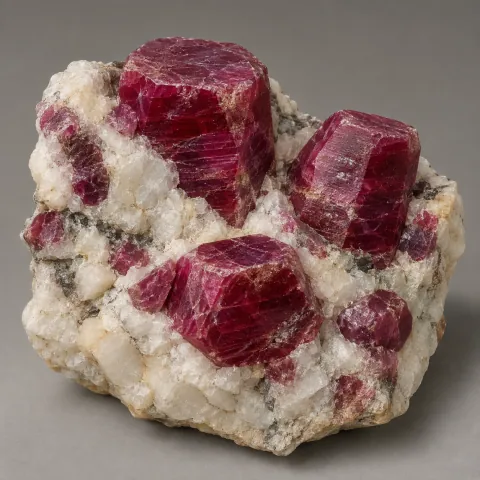
Ruby
Al₂O₃

COMPARE
Put up to four minerals or gems next to each other and test them like a gemmologist.
Al₂O₃
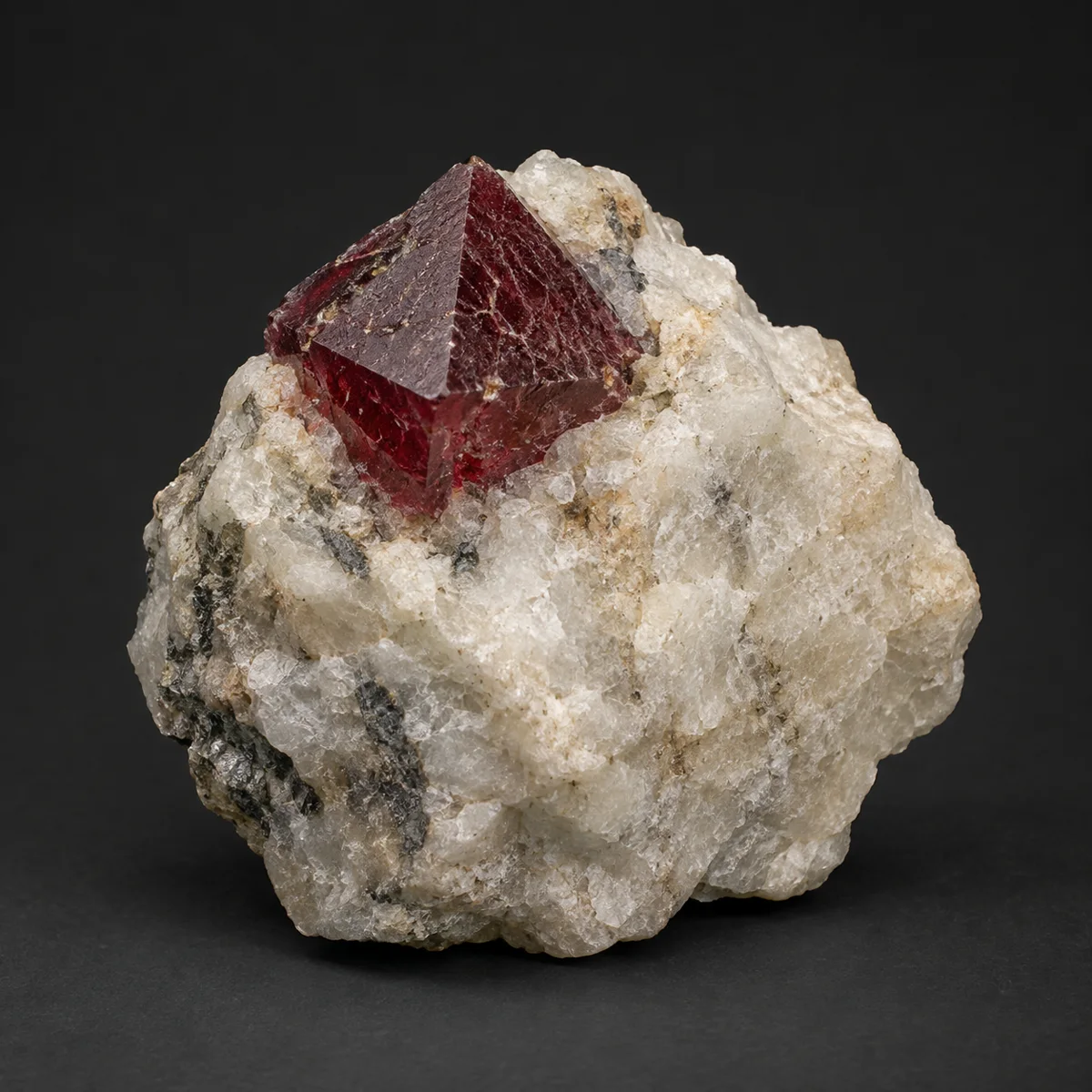
MgAl₂O₄
VERDICT
THE TESTS
Mohs hardness: a mineral scratches anything softer than itself.
Density in g/cm³: denser stones sink deeper.
Refractive index: how strongly the stone bends light. See light bend through a 3D crystal →
Between crossed polarisers a doubly refractive stone blinks as it turns; a singly refractive one stays dark. See light bend through a 3D crystal →
Unit cells side by side. Drag any of them: they all turn together.
RubyTrigonal
SpinelCubic
PROPERTIES
| Ruby | Spinel | |
|---|---|---|
| Type | Gem | Gem |
| Mineral | Corundum | Spinel |
| Formula | Al₂O₃ | MgAl₂O₄ |
| Mineral group | Oxides | Oxides |
| Crystal system | Trigonal | Cubic |
| Mohs hardness | 9 | 7.5–8 |
| Density | 3.98–4.10 g/cm³ | 3.6–4.1 g/cm³; composition controls the range |
| Refractive index | nω about 1.767–1.772; nε about 1.759–1.763 | n ≈ 1.719 for Mg-rich spinel; rises with Fe, Zn, and Cr substitution |
| Optical class | Uniaxial (−) | Isotropic |
| Colour | Red to purplish red | Red and pink are classic; also blue, violet and other colours |
| Colour cause | Chromium is the trace element behind ruby's red, which ranges from orangy red to purplish red; more chromium gives a stronger red. Chromium also makes ruby fluoresce red, which intensifies its colour. Rubies formed in marble, such as those from Myanmar, the Himalayas and northern Vietnam, contain little iron, so their red is especially intense. | Red spinel is coloured by chromium, the same trace element that colours ruby and emerald. |
| Treatments | Ruby can be treated to change its colour, apparent clarity or durability. GIA research has documented low-temperature heating, flux healing of fissures, and filling of fractures with glass. | — |
| Look-alikes | Red spinel is coloured by the same element, chromium, and was mistaken for ruby for centuries (see Spinel). Laboratory-grown ruby, with essentially the same chemical, physical and optical properties, also exists. | Spinel was mistaken for ruby for centuries, and many famous historical "rubies" are spinel — among them the Black Prince's Ruby set in the front of Britain's Imperial State Crown and the Timur Ruby, which weighs over 350 carats and carries several Persian inscriptions. The two were separated scientifically only in 1783, when Jean-Baptiste Louis Romé de l'Isle distinguished them by their crystal shapes (GIA reading list). |
| Crystal habit | Barrel-shaped, pyramidal, tabular, or prismatic crystals; also granular and massive. Parting and growth features may be prominent. | Octahedral crystals are classic; also dodecahedral, granular, or massive. Contact twins on {111} define the spinel law. |
| Cleavage | No true cleavage; common basal and rhombohedral parting | Imperfect parting on {111}; true cleavage is indistinct |
| Fracture | Uneven to conchoidal | Conchoidal to uneven or splintery |
| Tenacity | Brittle, but compact material is tough | Brittle |
| Luster | Adamantine to vitreous | Vitreous |
| Streak | White | White |
| Transparency | Transparent to opaque | Transparent to opaque |
| Fluorescence | Variable; ruby may fluoresce red under ultraviolet light and some material phosphoresces. | Usually inert, though some specimens fluoresce; trace elements can produce strong colour. |
| Identification | Its hardness of 9 is decisive: it scratches nearly every common mineral. High density and parting help distinguish it; ruby and sapphire are colour varieties of corundum, not separate mineral species. | Look for octahedral form, high hardness (7.5–8), lack of strong cleavage, and isotropic optics. Red spinel is singly refractive, unlike doubly refractive ruby. |
| In Tajikistan | Gem ruby is documented from the marble-hosted Snezhnoe deposit in the Kukurt district, Eastern Pamir. | Kuh-i-Lal in the Ishkoshim district is the historic source of gem spinel, the "balas ruby" of Badakhshan. |
| Source | Handbook of Mineralogy — Corundum | Handbook of Mineralogy — Spinel |